
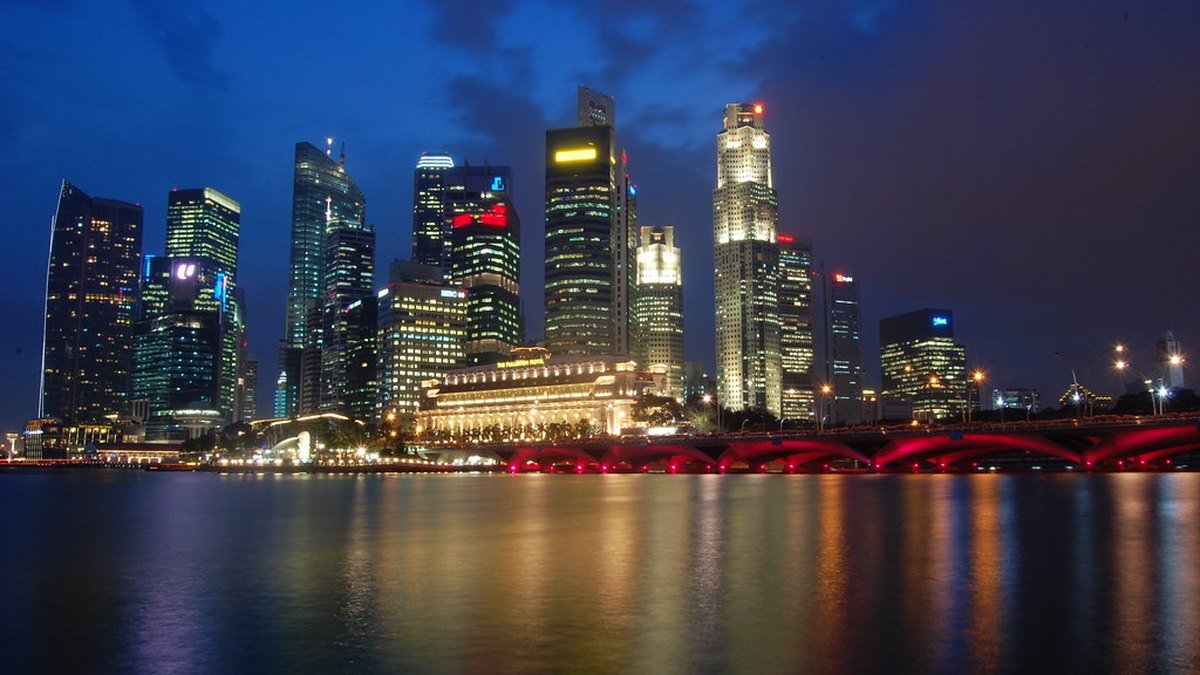
Key takeaways
- Singapore is a small, open economy that depends heavily on trade and investment.
- Its growth came from openness, education and sound, stable policy.
- Finance, manufacturing, trade and services are the main pillars.
- The exchange rate, not interest rates, is the main tool of monetary policy.
- High living costs and reliance on global demand are ongoing challenges.
Singapore’s economy is one of the most striking development stories of the modern era: a small island with no natural resources that became one of the wealthiest and most advanced economies in the world. It did so by staying open to trade, investing in people and building a reputation for reliability.
The result is a compact, highly diversified economy that punches far above its weight. Finance, manufacturing, trade and services all play major roles, woven together by world-class infrastructure and stable, predictable governance.
A small island with a big economy
Singapore’s economy defies its size. With a modest land area and population, it generates wealth comparable to much larger nations by concentrating on high-value activities and connecting itself tightly to the global economy. The absence of natural resources forced an early focus on human capital, skills and services rather than extraction.
This orientation shaped everything that followed. Because the domestic market is small, the economy looks outward, earning its living by trading goods and services with the wider world and by hosting the regional operations of international firms.
Size, in this case, became a discipline rather than a limitation. With little room for waste and no resource income to fall back on, the country had to make careful choices about where to compete. That constraint encouraged a focus on quality, productivity and specialisation that still characterises the economy today.
How prosperity was built
The path to wealth combined several deliberate choices. The government welcomed foreign investment and multinational companies, invested heavily in education and training, and maintained the political stability and clean administration that reassure investors. Infrastructure, from the port and airport to telecommunications, was treated as a priority.
Just as important was a culture of long-term planning. Policy tended to look years ahead, anticipating shifts in global demand and steering the economy toward activities where a small, skilled country could compete, rather than trying to do everything at once.
Public institutions played an active role in this process. Rather than leaving development entirely to the market, the state invested directly in industries, infrastructure and skills it judged to have long-term promise, while still relying on private enterprise and global competition to drive efficiency. This blend of planning and openness became a hallmark of the approach.
The main pillars of the economy
Several sectors carry the economy, and their balance has shifted over time as the country has moved up the value chain.
- Financial services, including banking, wealth management and insurance, make Singapore a regional hub for capital.
- Manufacturing, especially electronics, precision engineering, chemicals and biomedical products, remains a significant contributor.
- Trade and logistics connect the economy to global supply chains through the port and airport.
- Business and professional services support regional headquarters, legal work and consultancy.
An open economy and its trade-offs
Openness is Singapore’s defining economic feature. Trade in goods and services is large relative to the size of the economy, and the country has pursued free-trade agreements and investment links across the world. This openness brings prosperity, access to markets, technology and talent, but it also brings exposure.
Because so much depends on global demand, the economy feels the effects of international downturns, supply-chain disruptions and shifts in trade policy more quickly than more inward-looking economies do. Managing that exposure is a constant task. The health of the wider region matters too, as our overview of why Asia-Pacific drives global growth explores.
How monetary policy works
Singapore runs its monetary policy in an unusual way. Instead of targeting interest rates, the central authority manages the exchange rate of the local currency against a basket of trading partners’ currencies. For an economy where imports and exports loom so large, the exchange rate is a more powerful lever for controlling inflation than domestic interest rates would be.
This approach reflects a broader principle: policy is tailored to the country’s specific circumstances rather than borrowed wholesale from larger economies. It has helped keep inflation relatively contained while supporting trade competitiveness.
The economy is also supported by prudent public finances and substantial national reserves built up over time. This financial cushion gives the country room to respond to shocks and to invest through downturns, reinforcing the sense of stability that attracts businesses and investors in the first place.
Challenges and the road ahead
No economy is without strains. Singapore faces high living and business costs, an ageing population and reliance on foreign labour and global demand. Competition from other regional centres is persistent, and the country must keep upgrading skills and industries to stay ahead.
The response has been to lean into higher-value activities: research and innovation, advanced manufacturing, digital services and sustainable finance. Rather than defending old advantages, the strategy is to keep moving toward whatever the global economy will value next. These are trends rather than certainties, and outcomes will depend on conditions well beyond the island’s control.
What the Singapore model shows
Singapore’s economy is often studied because it demonstrates what focus, openness and stable governance can achieve even without resources or scale. It is not a model that transfers perfectly to every country, since much depends on location and circumstance, but its core lessons, invest in people, stay open, plan for the long term and build trust, have a wide relevance across Asia-Pacific and beyond.
Frequently asked questions
What kind of economy does Singapore have?
It is a small, highly open and advanced economy that relies on trade, finance, manufacturing and skilled services, and on connections to the global economy rather than a large domestic market.
What are the main sectors of Singapore’s economy?
The main pillars are financial services, manufacturing (such as electronics, chemicals and biomedical products), trade and logistics, and business and professional services.
Why doesn’t Singapore target interest rates?
Because the economy is so trade-dependent, the authorities manage the exchange rate against a basket of currencies instead, which is a more effective way to control inflation in an open economy.
What challenges does Singapore’s economy face?
High living and business costs, an ageing population, reliance on foreign labour and strong dependence on global demand all pose ongoing challenges.